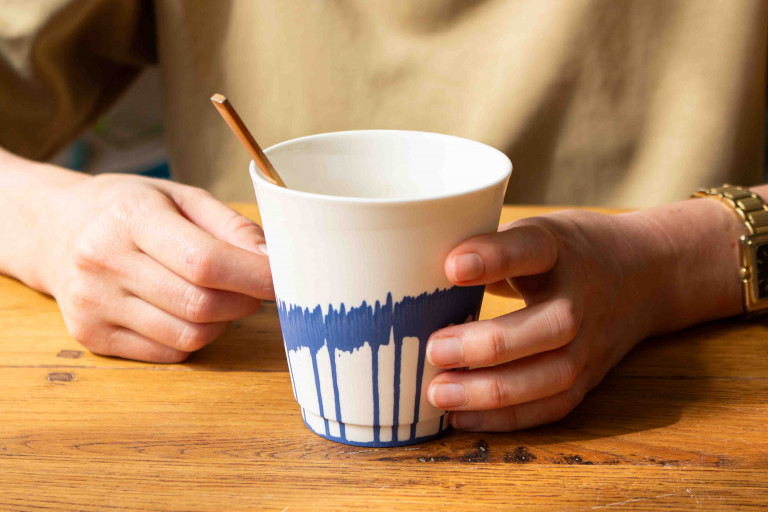
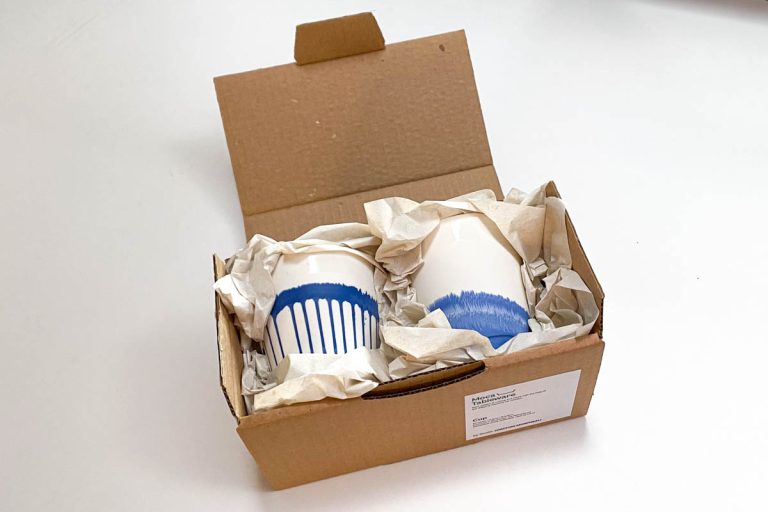
During Dutch Design Week 2026 (17 to 24 October), we launched our first porcelain painting workshop, “Your Delft Blue”, in our studio at Strijp-T in Eindhoven. Over 12 sessions, we welcomed (exactly!) 100 people, who painted more than 140 plates, cups and bowls. The idea: a blend of contemporary design and traditional Delft Blue techniques.
To be honest, we didn’t expect it to be such a success. We should even have prepared more bisque-fired pieces: all the extra cups and bowls were gone in no time!
In this article, we share how it went, the techniques our guests used, and what they created. And if you feel like joining one of our next workshops in Eindhoven, you are more than welcome!

Why Delft Blue, and why a contemporary take?
Delft Blue is probably one of the most famous Dutch crafts. It started in the 17th century, when potters in Delft began making their own version of the blue-and-white porcelain arriving from China. Fun fact: traditional Delft Blue isn’t porcelain at all, but earthenware covered with a white glaze and painted in cobalt.
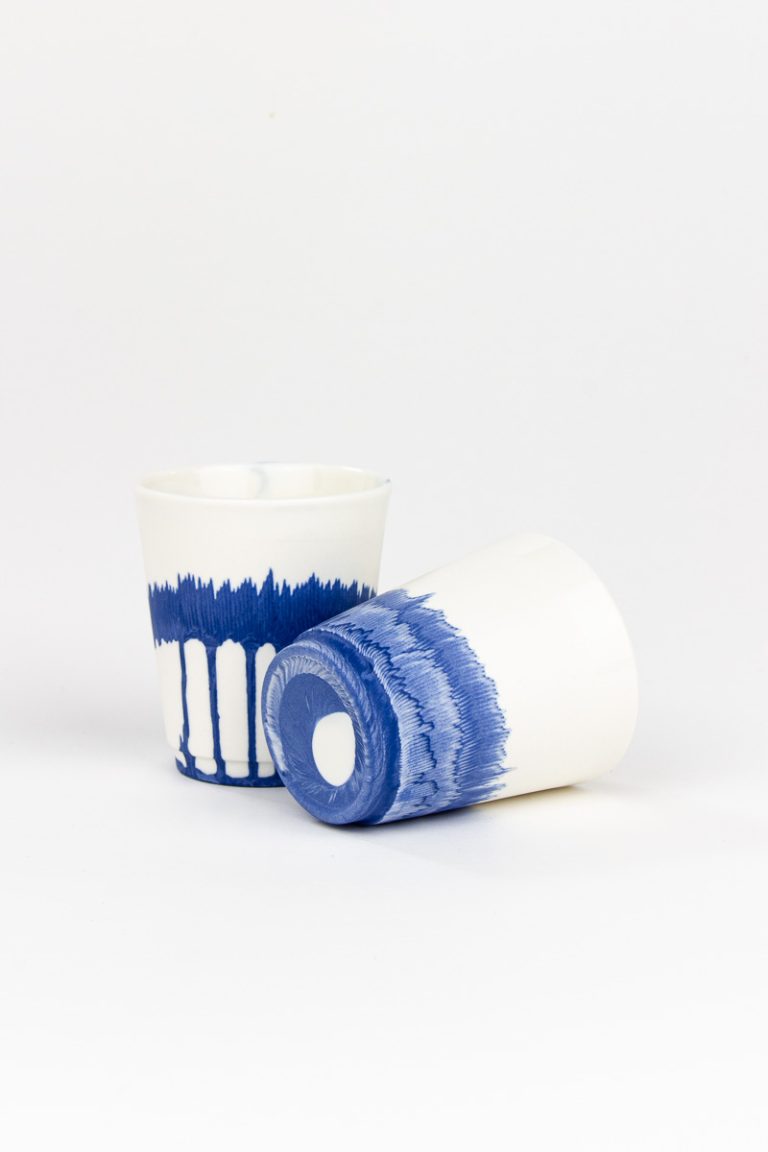
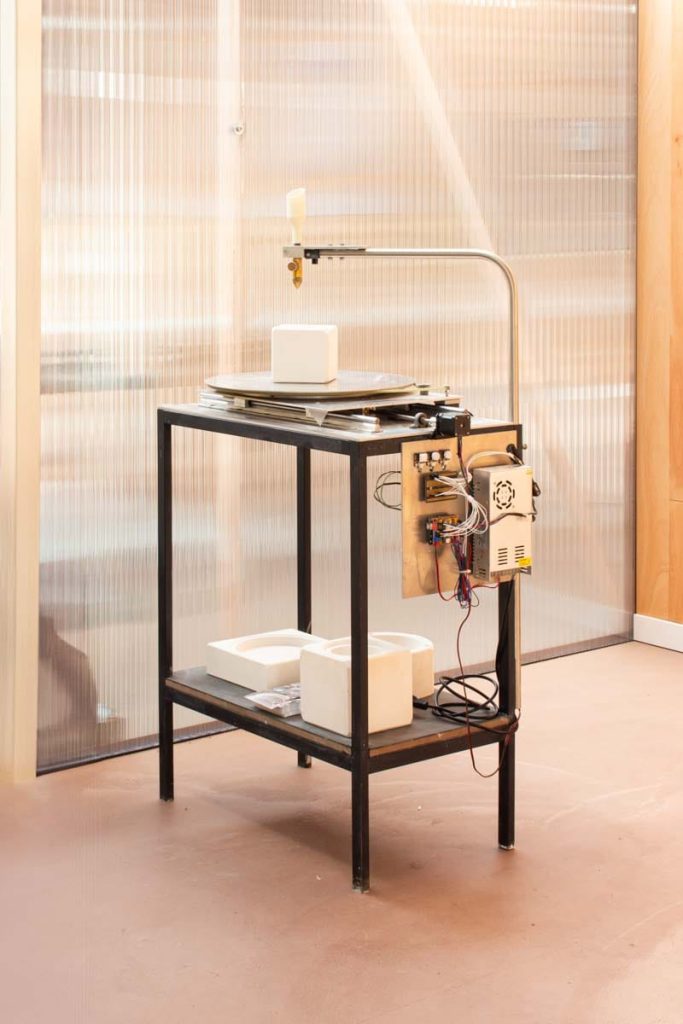
At MOCA Tableware, the porcelain brand of our design studio Studio Joachim-Morineau, Carla Joachim and I (Jordan Morineau) produce our own porcelain, combining industrial and handmade processes. For this workshop, we wanted to keep the soul of Delft Blue (the cobalt, the brush, the hand-painted motifs) and mix it with our own dripping technique: cobalt glaze poured over the piece by the dripping machine we built, creating patterns no one can fully predict!
The idea was never to copy old Delft motifs, but to let everyone find their own creative version of the blue.


A workshop session at our Eindhoven studio, step by step
Every session started slowly, usually in the morning, with a coffee or tea in our workshop area. It was the perfect moment to meet and chat with everyone. We then took a few minutes to introduce our studio, our work, and the story of Delft Blue, so everyone knew where we were heading, and gave a live demo of our dripping machine.
Next, we explained the technique before anyone tried it: how much cobalt to load, how much water to add, how to sketch with a pencil first, and so on. After that, it was time to paint! For about two and a half hours, everyone worked on their own piece. Some people came fully prepared, with sketches, Pinterest boards, and ideas they had been thinking about (we had sent an email beforehand, so they could start dreaming up their design). Others started from a blank plate and simply let it come.
Carla and I loved walking around the table, talking with each person about their ideas, giving tips and answering questions. Always a great moment, especially as people often started chatting with each other and sharing ideas!


The Delft Blue techniques our guests used
Free brush painting in cobalt
Most guests started with a brush and cobalt. Some went for classic Delft Blue: flowers, blossoming branches, delicate borders. Others made it completely their own: cats (lots of cats!), a fox, a kiwi bird, mushrooms, a sea turtle swimming through coral, someone dancing in the rain with an umbrella, initials and little messages for loved ones.
Our main tip was to sketch lightly with a pencil first (it disappears once fired), then build up the blue little by little. More water gives soft, light shades; less water gives a deep, intense blue. We also asked everyone not to load too much cobalt (which, to be honest, is harder than it sounds), so that the plate stays food-safe once it’s fired with the glaze we add on top.
Our dripping machine
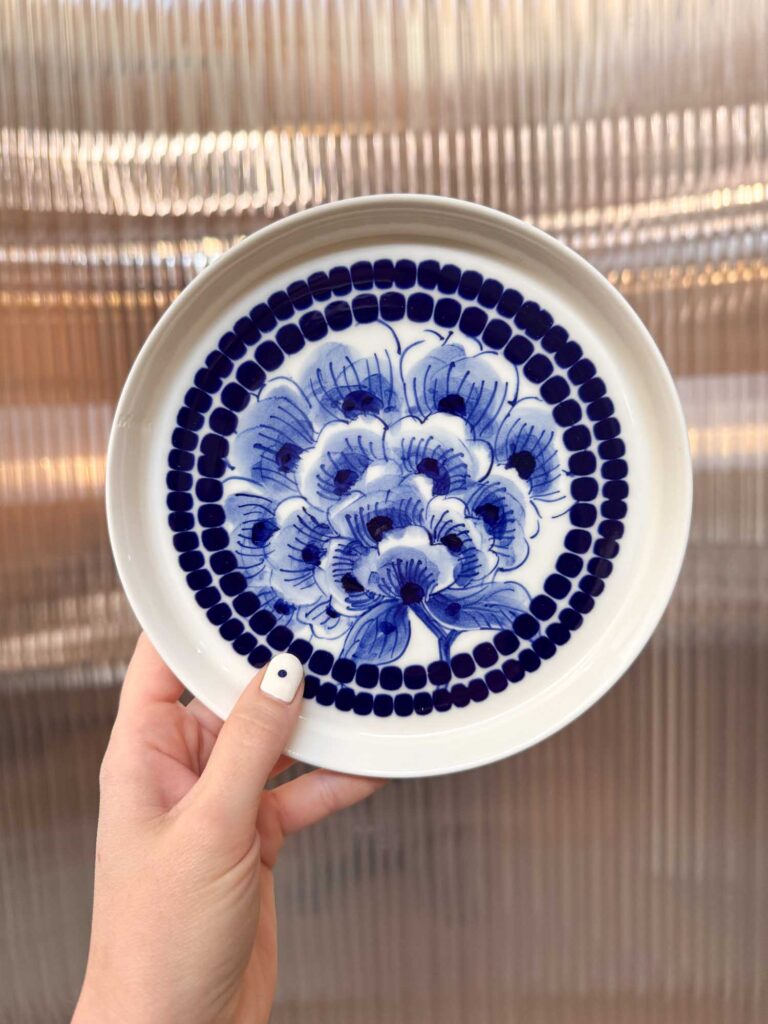
The machine was also a big hit. It drops cobalt glaze onto the plate, usually creating our signature deep blue dots. Many guests used it to frame their drawing with one, two or even three rings of dots. Others used it more freely, blowing drops across the plate or making them the main pattern, like drops becoming the centre of flowers. Some guests started with the drops and painted around them; others finished their plates with them. Seeing our machine give such different results was honestly one of our favourite parts of the week!
Inventing their own techniques
And then some people simply invented their own way of working. Water was the big discovery: by wetting the plate or diluting the cobalt, guests created watercolour-like clouds, marbled textures and soft blooms where the blue spreads on its own. Others splattered cobalt with their brush like a starry sky, or covered the whole plate in wide, energetic brushstrokes. Someone even used big drops of water and cobalt for a rain-like effect. There were no strict rules: everyone could experiment, knowing there’s no going back once the blue is on the plate. And that’s exactly what we hoped for!


What 100 people created
was running non-stop: more than 140 plates, cups and bowls, painted by 100 people. Most were Dutch Design Week visitors, many living in the Netherlands, others from much further away.
It was really nice to see people inspiring each other: some came with plenty of ideas ready, others picked them up around the table as the session went on. Here are some of the results: classic, abstract, funny or very personal, and not a single one the same!




From the workshop to the kiln: what happens next?
Once the workshop was over, our work wasn’t quite finished! Carla and I glazed every piece by hand and fired them all in our kiln at the studio. That’s when the cobalt reveals its final colour, and the plate becomes food-safe and dishwasher-safe. One to two weeks later, everyone could come back to the studio to collect their pieces, or we shipped them.
Opening the kiln full of everyone’s plates was always a surprise for us: would they turn out the way everyone imagined?
What we learned from our first workshop series
Twelve sessions in eight days taught us a lot (and kept us very, very busy!). First, starting slowly with coffee or tea, plus our homemade chocolate cakes and cookies, really makes a difference: everyone feels at ease before they even touch a brush. Taking the time to talk with each person was also something both we and our guests really enjoyed.
We also learned to leave more room for experiments. Seeing guests use our machine in their own way and invent techniques we had never thought of, showed us that the best results often come from trying things out. And for the next sessions, one thing is sure: we’ll prepare a lot more cups and bowls!


Workshops at our Eindhoven studio: what’s next?
“Your Delft Blue” was our very first workshop, and definitely not the last! We’re already adding new sessions, and new themes and techniques will follow (did someone say Christmas?). Looking for a creative ceramic workshop in Eindhoven? No experience needed, just curiosity.
- Join a session: see the upcoming dates and book your seat on our workshops page.
- Come with your team or group: we also host private workshops for companies and groups, at our studio or at a venue of your choice.
- Never miss a date: follow us on Eventbrite and Instagram.
See you soon at our studio: Strijp-T Eindhoven.
Thank you!
Jordan Morineau & Carla Joachim from Studio Joachim-Morineau